They are ill discoverers that think there is no land, when they can see nothing but the sea.
- Sir Francis Bacon.
Showing posts with label Poetry. Show all posts

Tuesday, December 23, 2008

Cocktails for the ladies!


Για να μείνουμε, όπως συνηθίζεται και οφείλουμε, στο πνεύμα των ημερών, ας μιλήσουμε για κοκτέιλ!


Ο σοβιετικός εξοπλισμός που είχε αγοράσει με τα αποθέματα χρυσού της η Ισπανική κυβέρνηση άρχισε να φτάνει ακριβώς τις ημέρες που ο στρατός των πραξικοπηματιών ξεκινούσε την πολιορκία της Μαδρίτης, στα τέλη του Οκτώβρη του 1936.

Τα σοβιετικά τεθωρακισμένα Τ-26 αποδείχθηκαν πολύ ανώτερα απο τα Panzer Mk I που είχαν προμηθεύσει τον Στρατηγό Franco οι Γερμανοί.

Ένα τέχνασμα που χρησιμοποίησαν οι εθνικιστές για να αντιμετωπίσουν αυτή την προσωρινή υπεροχή των δημοκρατικών σε εξοπλισμό ήταν αυτοσχέδιες βόμβες μίγματος νάφθας - βενζίνης σε γυάλινο μπουκάλι, οι οποίες μπορούσαν σε ορισμένες περιπτώσεις να πυρπολήσουν ένα τεθωρακισμένο όχημα με ανεπαρκή στεγανοποίηση.


Τρία χρόνια μετά, στον Χειμερινό Πόλεμο Σοβιετικής Ένωσης - Φινλανδίας, ο Κομισάριος Εξωτερικών της Σοβιετικής Ένωσης, Βιάτσεσλαβ Μολότωφ, δήλωνε ότι οι βομβαρδισμοί των Φινλανδικών πόλεων ήταν στην πραγματικότητα ρίψεις τροφίμων στους λιμοκτονούντες Φινλανδούς.

Οι Φινλανδοί, ευγενέστατοι όπως πάντα, αναγνώρισαν τη μεγαλοψυχία και ονόμασαν αυτές τις αυτοσχέδιες βόμβες με τις οποίες πυρπολούσαν τα Σοβιετικά τεθωρακισμένα:
"Κοκτέιλ Μολότωφ"


Κερνώντας τις δεσποινίδες μερικά κοκτέιλ!
(6-12-2008 – ΤΗΕ DIGITAL ALBUM )


Ελάτε να δείτε το αίμα στους δρόμους,
Ελάτε να δείτε
Το αίμα στους δρόμους,
Ελάτε να δείτε το αίμα
Στους δρόμους!


( Venid a ver la sangre por las calles,
venid a ver
la sangre por las calles,
venid a ver la sangre
por las calles! )

Pablo Neruda, 'Explico algunas cosas'

.

Friday, August 15, 2008

Closing Time


My country: the sun setting beyond the Cretan hills


The wonderful surprises that only summer can bring...or, how just one night can get you on the right track. A word, a touch, a sunset, the beach and then a wonderful concert and the lyrics are aglow with meaning and substance.

And no, it is only tomorrow that I am leaving for the traditional August vacations (and I will never say again that something like that will be boring beacause summer does have its ways of surprising us) but I have not been staying at home much these last two weeks, so that is why I have posted close to nothing.

I will not be away for the whole August but I will not be posting till September. I have a mind to follow by mood the eventides of the academic year, you see.... Old habits die hard.

For this temporary leave of absence (and with your permission of course...;), kind readers, I would like to share with you one of the later songs by that wonderful gentleman, the true master of emotional eloquence, the one and only, Leonard Cohen: Closing Time


Closing Time

Ah we're drinking and we're dancing
and the band is really happening
and the Johnnie Walker wisdom running high
And my very sweet companion
she's the Angel of Compassion
she's rubbing half the world against her thigh
And every drinker every dancer
lifts a happy face to thank her
the fiddler fiddles something so sublime
all the women tear their blouses off
and the men they dance on the polka-dots
and it's partner found, it's partner lost
and it's hell to pay when the fiddler stops:
it's closing time

Yeah the women tear their blouses off
and the men they dance on the polka-dots
and it's partner found, it's partner lost
and it's hell to pay when the fiddler stops:
it's closing time

Ah we're lonely, we're romantic
and the cider's laced with acid
and the Holy Spirit's crying, "Where's the beef?"

And the moon is swimming naked
and the summer night is fragrant
with a mighty expectation of relief

So we struggle and we stagger
down the snakes and up the ladder
to the tower where the blessed hours chime
and I swear it happened just like this:
a sigh, a cry, a hungry kiss
the Gates of Love they budged an inch
I can't say much has happened since
but closing time...

I swear it happened just like this:
a sigh, a cry, a hungry kiss
the Gates of Love they budged an inch
I can't say much has happened since
closing time

I loved you for your beauty
but that doesn't make a fool of me:
you were in it for your beauty too
and I loved you for your body
there's a voice that sounds like God to me
declaring, declaring, declaring that your body's really you
And I loved you when our love was blessed
and I love you now there's nothing left
but sorrow and a sense of overtime
and I missed you since the place got wrecked
And I just don't care what happens next
looks like freedom but it feels like death
it's something in between, I guess
it's closing time

Yeah I missed you since the place got wrecked
By the winds of change and the weeds of sex
looks like freedom but it feels like death
it's something in between, I guess
it's closing time

Yeah we're drinking and we're dancing
but there's nothing really happening
and the place is dead as Heaven on a Saturday night
And my very close companion
gets me fumbling gets me laughing
she's a hundred but she's wearing
something tight
and I lift my glass to the Awful Truth
which you can't reveal to the Ears of Youth
except to say it isn't worth a dime
And the whole damn place goes crazy twice
and it's once for the devil and once for Christ
but the Boss don't like these dizzy heights
we're busted in the blinding lights,
busted in the blinding lights
of closing time

The whole damn place goes crazy twice
and it's once for the devil and once for Christ
but the Boss don't like these dizzy heights
we're busted in the blinding lights,
busted in the blinding lights
of closing time

Oh the women tear their blouses off the men they dance on the polka-dots
It's closing time
And it's partner found, it's partner lost
and it's hell to pay when the fiddler stops
It's closing time
I swear it happened just like this:
a sigh, a cry, a hungry kiss
It's closing time
The Gates of Love they budged an inch
I can't say much has happened since
But closing time...
I loved you when our love was blessed
I love you now there's nothing left
But closing time...
I miss you since the place got wrecked
By the winds of change and the weeds of sex.


So, for now, kind readers, enjoy the rest of the summer and stay tuned... the Bishop will remember you in his benedictions.


.


Wednesday, June 18, 2008

Waterloo!

On 18 June 1815 the armies of the Seventh Coalition (Great Britain, Prussia, the United Netherlands, Nassau, Hanover and Brunswick) under the command of Arthur Wellesley, First Duke of Wellington ("the Iron Duke" - "Whoever soils a Wellington puts his foot in it") and of Generalfeldmarschall Gebhard Leberecht Graf von Blücher ( "Marschall Vorwärts" ) met and defeated the army of Napoleon Bonaparte in the famous Battle of Waterloo, in "a damn close-run thing".

For now two things:

First, the ABBA song "Waterloo" from the 1974 Eurovision song contest (notice the orchestra conductor Sven Olaf Walldoff with his Napoleon costume)


and a witty poem by some Thomas Gaspey about Lord Uxbrige's (Henry Paget's) leg that had become a tourist attraction in Waterloo when it was lost to grapeshot from the French artillery (with the famous anecdotal dialogue between Uxbridge and the Iron Duke: "By God, sir, I've lost my leg!" - "By God, sir, so you have!" ) :


Here rests, and let no saucy knave
Presume to sneer and laugh,
To learn that mouldering in the grave
Is laid a British calf.

For he who writes these lines is sure
That those who read the whole
Will find such laugh were premature,
For here, too, lies a sole.

And here five little ones repose,
Twin-born with other five;
Unheeded by their brother toes,
Who now are all alive.

A leg and foot to speak more plain
Lie here, of one commanding;
Who, though his wits he might retain,
Lost half his understanding.

And when the guns, with thunder fraught,
Pour'd bullets thick as hail,
Could only in this way be taught
To give his foe leg-bail.

And now in England, just as gay -
As in the battle brave -
Goes to the rout, review, or play,
With one foot in the grave.

Fortune in vain here showed her spite,
For he will still be found,
Should England's sons engage in fight,
Resolved to stand his ground.

But fortune's pardon I must beg,
She meant not to disarm;
And when she lopped the hero's leg
By no means sought his h-arm,

And but indulged a harmless whim,
Since he could walk with one,
She saw two legs were lost on him
Who never meant to run.


.


Wednesday, May 21, 2008

Imperial Journey: La Montanara
(Das Lied der Berge)

On May 7, I landed at Charles de Gaulle airport to begin an arduous descent by train across the lands of the overlapping Empires of Europe. Before I write anything about the routes and stops of my imperial journey, I would like to publish some photos of my visit to the Alps, which was probably what moved me the most. Accompanied by a Tölzer Knabenchor video of them singing La Montanara (Das Lied der Berge), the hymn of the mighty Alps, whose lyrics I used as legend for the pictures:


Hörst du das Lied der Berge?
Die Berge sie grüßen dich

(Do you hear the song of the mountains?
The mountains salute you)


Hörst du mein Echo schallen
Und leise verhallen?

(Do you hear my echo ring out
and quiet down? )


Dort wo in blauer Ferne
Die Welten entschwinden
Möcht' ich dich wieder finden
Mein unvergessenes Glück?

(Over there, where the worlds vanish
in the blue distance
may I find you once more,
my unforgettable happiness?)


La Montanara, ohe !!!


Von Ferne rauscht der Wasserfall

(In the distance, the waterfall roars!)


Und durch die grünen Tannen
Bricht silbern das Licht

(And through the green firs
silver the light shines )


La Montanara, ohe !!!

Im Klang alter Lieder
Laut hallt mein Echo wieder
Nur du hörst es nicht

(In the sound of old songs
Loudly my echo rings out
and only you don't hear it)


Weit sind die Schwalben
Nach Süden geflogen
Über die ewigen Berge und Täler

(Away to the south
have the swallows flown
over the eternal mountains and valleys)


Und eine Wolke
Kam einsam gezogen

(And a cloud came,
drawn close, solitary)


Doch wart' ich immer
Vergeblich auf dich...

(Yet I wait for you,
forever in vain...)


PS I: Locations: Airbus A340-300 above the Alps, Innsbruck and surrounding area, Hafelekar mountain summit (2334m ), Swiss-Italian border (Lugano area)

PS II: All photos by me, ©. Click to enlarge.

PS III: No, I did not find a f@#%&ng Edelweiss, it was too early, everything was covered in snow...


PS IV: Dulljöh !


.


Tuesday, April 22, 2008

The Orient Express route!

Ah... those precious moments of clarity....

Looking up a couple of things in Thomas Pynchon's masterpiece Gravity's Rainbow I remembered a witty song appearing in one of the first chapters:

Nobody knows where it is on the map
Who'd ever think it could start such a flap?
Each Montenegran and Serbian too,
Waitin' for something, right outa the blue - oh honey!
Pack up my Gladstone 'n' brush off my suit,
And then light me up my big fat cigar -
If ya want my address, it's
That Orient Express
To the sanjak of Novi Pazar!

The idea of passing from the Middle East to the Balkan Issue in less than a month! And to trace the route of the Orient Express (even in an erratic way...) Alternating imperial luxury and balkan seediness, over a period of a couple of weeks! What an idea!

Now is the time for decisions! Leaving tomorrow for my first port of call!


PS I: A gladstone is the typical hinged leather suitcase (named after the Prime Minister, William Ewart Gladstone).


"What a way for a fashionable painter to travel, a Gladstone bag and an ulster"
- Dorian Gray.

Oscar Wilde, The Picture of Dorian Gray

PS II: My first port of call? A hint: Even old New York was once New Amsterdam...


.

Monday, April 21, 2008

Journey to the Outremere:
The Knights


Salah ad-Din Triumphant near the entrance of the Hamidinyeh souk in Damascus (click photos to enlarge)


Until I gather my thoughts about my first visit to the Outremere into a semblance of coherence (thus formulating my first assumptions about the Middle-East issue - or, rather, Issue ) let me state for those of you who ask that I did not mean to trace the footsteps of the Crusaders.

Damascus, April 2008: Me at the statue of the Triumph of the great warrior-king, Salah ad-Din (photo by Dimitris Dimopoulos)

I think I did a hell of a job in avoiding them alltogether, the first step being the decision to steer clear of Tripoli (Trabulus) and Homs (with the Krak des Chevaliers). However, it seemed that there would be much to avoid even in the south of Lebanon, what with Tyre, Sidon and all. Or was there...?

View of the city of Sidon from the top of the ruins of the Sidon Sea Castle

Li frere, li Mestre du Temple
Qu’estoient rempli et ample
D’or et d’argent et de richesse,
Et qui menoient tel noblesse,
Ou sont-il? que sont devenu?
Que tant ont de plait maintenu,
Que nul a elz ne s’ozoit prendre
Tozjors achetoient sans vendre
Nul riche a elz n’estoit de prise;
Tant va pot a eue qu’il brise.

(Chronique à la suite du Roman de Fauvel)


That was my question as well. What happened to the brothers, the Masters of the Temple, full and resplendent in their riches, their gold and silver and their nobility? Where were their castles? Where were the ruins that would point to the knightly past of Tyre and Sidon?


Roman columns as horizontal supports for the walls of the Sea Fortress at Sidon

The answer more or less is: not to be found. The overthrow of the Crusaders was complete and most testaments of their passing were razed. The few ruins that remain tell a sad story of opportunistic unstable rule and very low grade of integration of the local populace.

For this, the statue of Salah ad-Din stands triumphant in Damascus, with the heretical, greedy, honourless, cowardly and insolent Templars (forever a curse and an anathema to their order: anathema, anathema, anathema ), Renald de Chatillon and Guy de Lusignan at the rear feet of his horse, desolate and defeated. Anathema sit!


The defeated: Renald de Chatillon (Salah ad-Din rid the world of this worm by beheading him after the Crusader disaster at the Horns of Hattin) and the so-called-King Guy de Lusignan... note the sack of plunder! (photo by Dimitris Dimopoulos)

Besides... there were more interesting and important things to see and experience in the psychological epicentre of the Middle East Issue...:

The walls of Beyruth cry bitter tears...

PS: Let there be, now and forever, an anathema to the name of anyone who is in anyway associated with the filth, heresy, witchcraft and insolence of the Knights Templar. May his face be forever black. May his soul burn in the eternal fire. Anathema sit! Anathema, anathema, anathema....

PS II: Still the "occult" legacy of the templar vermin persists if one knows where to look: In a back alley of Tyre, above a graveyard entrance consigned in 1948... a Templar cross! In black and white, the colours of the Beauceant... anathema: !


.

Monday, February 25, 2008

Silence and distance

Deus ao mar o perigo e o abismo deu,
Mas nele é que espelhou o céu.
----------------------
To the sea God gave gave peril and the abyss
But He also made Heaven to be mirrored in it.

Fernando Pessoa, Mar Português, Mensagem.

The Sea is an enchanting and unforgiving mistress. Her charms are matched only by the dangers that contact with her entails. She brands irrevocably anyone open to her wiles. Out there, the measure of a man's worth is constantly weighed against her seduction at the cost of his own life as well as the lives of his mates.


This mystique is what surrounds populations that come in close contact with the sea and makes them so different. The unmistakable air of cosmopolitan nobility combined with the far-reaching gaze into the sea in search of the beloved ones returning.

I will be returning to her as often as I can. It was about time I started from the basics...


For those that showed me what all this really means:


"Silence and Distance" (Andre Matos)


Been here for so long
On the morrow I'll dare
Silent and distant
Reaching out, unaware
Stealing the whispers
From my deepest request

And you watch me
Waiting for something new
My hands, as empty
As my body and soul
Could keep pretending
But in the heart I'd be gone...

Still stare at my face
But lost seem your eyes
Keep hold of the sails
Against the blue sky

Ooh, I'm intending
A way back to the sea
This emptiness burns inside
And leads on for endless miles

Don't let me go
Away across the sea,
It may be much more wide
Than what it seems to be

Oh, I'm still searching
The way back to be freed
The loneliness hangs around us
However we can't see

Now let me go
Away across the sea,
The waves can't be as high
As they pretend to be

And now I know
In my heart, I won't forget
The sails against the blue sky
That taught me how to live

... with no sorrow
And tomorrow we'll share
Silence and distance
'till our faults are repaired
You'll be the mistress
Who I'll never forget.

Για το Γιάννη, τη Μαριάννα, τον Πέτρο, τη Ματούλα, τη Μαρίκα, τη Δέσποινα... για τα χρυσά απογεύματα στο Μερσινίδι...

Sunday, February 10, 2008

The Meaning of Life pt. III: Fighting each other. -
Would I fight?

(Greek War Flag flying Greek colours and St. George, the patron saint of the Greek Land Army killing the serpent - October 2006)

One year ago I completed my compulsory time of service in the Greek Army. The "anniversary" was 2 days ago but illness prevented any celebrations.

(6-inch Guns of the Artillery firing blank salvoes to salute celebrations of Greek 28 October National Holiday)

The question, even though one year has passed, still remains haunting: Would I fight and possibly die? And, if yes, why?

(Second posting special forces - winter 2006-7 : I must have been really pissed off that day...)

The answer to the first question is easy. I am now under oath and I would do it. Not because of the oath per se.
Oaths have a special mystique of their own and the very notion of allegiance to death resonates deep into the soul of a warrior. And it has proven destructive, as it was demonstrated when during the Second World War most officers of the Wehrmacht stayed true to their oath of allegiance to Adolf Hitler even though he was clearly leading Germany to total annihilation.

(First posting -infantry - autumn 2006 :"Hey Doc, do you know anything about electronics?" "Yes Lieutenant, as a matter of fact quite a few things..." "Ok then, you get the radiophone..." αργότερα... πού'σαι ρε μαλάκα Αντωνιάδη, πάρε με στο κινητό δε λειτουργεί αυτη η μαλακία που μου δώσανε...)

But, no, I am afraid and very sorry to say that it is not the oath to the flag that would be my main drive to fight. Very sorry indeed to say that because many people, many good people died for that flag.

(Second posting -special forces winter 2006-7: Hellenic Air Force C-130 Hercules approaching paratrooper drop zone for the first sortie of the day)

In all honesty, who would appreciate the idea to die for a country run by worthless and utterly corrupt politicians, petty and unworthy servants scurrying to do the bidding of mindless masters dealing in high-stakes finance? Who can forget that the fat blubbering slobs that claim to represent the people of Greece are smugly seated in their parliament chairs simply by stepping on the bodies of the young men that died under the treads of tanks fighting for an ideal that has become what we now try to pass as democracy?

(Infantry grenade launcher - first posting - summer 2006 - why would a doctor need a grenade launcher anyway? but of course to show off...)

(First posting - infantry - summer 2006 :Aboard a Hummer with a mounted KORNET anti-tank missile launcher. Note the funny "shoot the doctor first" helmet)

No, the ideal is dead and its carcass is being raped everyday by politicians, journalists and civil servants all across the country.

(Second posting - special forces - John Rambo beware...)

(Second posting - special forces winter 2006-2007 : "Hey Sarge, where are my medical supplies?" "We'll deliver them to the dressing station, doc!" Instead of medical supplies I got 3 crates of hand grenades. Guaranteed to permanently cure anything out of existence)

I would fight for it is in our nature to do so. Because the aggressors would try to impose a new order that would inevitably be worse than the present status. And it is only natural to resist that.

(Second posting - special forces - 08 February 2007 - On my discharge day. Not allowed a moment of respite even on my discharge day I got to cover a paratrooper landing covered by Malcolm Brabant for BBC World on a report on those pussies that are dodging conscription to the Greek Army - watch the video here: Greek crackdown on draft dodge. I got to be on BBC TV as "Dr. George Papadimitropolous". At least they got it half-right...)

And not because we cannot bear the yoke if need be. Humans can tolerate and get used to almost anything. What I would and could not bear however is the indignity of seeing the people I love bear that yoke.

I can think of no better words than those of the poet Richard Lovelace,one of the Cavalier poets who fought for King Charles against Oliver Cromwell. From his poem:

To Lucasta: Going to the Warres

I.
Tell me not, (sweet,) I am unkinde,
That from the nunnerie
Of thy chaste breast and quiet minde
To warre and armes I flie.

II.
True: a new Mistresse now I chase,
The first foe in the field;
And with a stronger faith imbrace
A sword, a horse, a shield.

III.
Yet this inconstancy is such,
As you too shall adore;
I could not love thee, dear, so much,
Lov'd I not Honour more.


You see, I would fight for the people next to me. I would fight for my friends. I would fight for my family. I would fight for my childhood playgrounds. I would fight for the one I love. I would fight so that her eyes remain unclouded of tears. And I would die, I would die a thousand deaths rather than having to bear the shame of having to watch this. How can someone love anyone, if one does not love Honour more?

PS. To lighten things up a bit: "A man may fight for many things: his country, his principles, his friends, the glistening tear on the cheek of a golden child. But personally I'd mud-wrestle my own mother for a ton of cash, an amusing clock and a sack of French porn. - Edmund Blackadder The Third.


(In 2007 Santa Claus arrived with a free-fall parachute. This year I hope he chose something more convenient that allowed for more gifts...)

Tuesday, February 5, 2008

Der Panther

After the neo-greek interlude, we return to the artistic production of civilized nations: I hereby post Rainer Maria Rilke's famous poem Der Panther along with my attempt at translation.


Der Panther

Im Jardin des Plantes, Paris

Sein Blick ist vom Vorübergehn der Stäbe
so müd geworden, dass er nichts mehr hält.
Ihm ist, als ob es tausend Stäbe gäbe
und hinter tausend Stäben keine Welt.

Der weiche Gang geschmeidig starker Schritte,
der sich im allerkleinsten Kreise dreht,
ist wie ein Tanz von Kraft um eine Mitte,
in der betäubt ein großer Wille steht.

Nur manchmal schiebt der Vorhang der Pupille
sich lautlos auf -. Dann geht ein Bild hinein,
geht durch der Glieder angespannte Stille -
und hört im Herzen auf zu sein.


6.11.1902, Paris

The Panther

At the Jardin des Plantes, Paris

His gaze,from pacing behind the bars that stand before him
has grown so exhausted that there's nothing it can hold
It seems to him as if there are a thousand bars before him
and beyond these thousand bars no world.


The soft footfalls, the supple muscular canter
that goes about in ever-smaller turns
is like a dance of power around a fixed center
in which, like dazed, a greater spirit burns.

And only at times the curtain that obscures the sight
silently parts -. Right then an image shoots through the eye
goes through the limbs - then strained quiet -
straight to the heart only for it to die.

(1) "fixed" in stanza 2, line 3 to be read fix-ed and not fix'd
(2) "quiet" stanza 3 line 3, noun and not adjective.
(3) Stanza 3 awkward in form and metre but read aloud it actually sounds good and retains cadence.

[Despite the fact that I faced it like Nabokov, as a predetermined failure and with annotation as deemed necessary, I think the effort is not bad, so I stick to my copyright (whatever that means on the internet) and reproduction only with mention of this source, my blog.]


EDIT 6/2/2008:

I received feedback for the poem by Brian Jones who noted that "lay before him" [stanza 1] (referring to the bars of the cage) conveyed the image of horizontal bars, instead of vertical ones. Indeed, it was an inappropriate selection, so I replaced it with "stand" as was his suggestion as well. Another correction was made as well since footfalls was "footfals".

Brian Jones keeps a treasury of the arts and lore from the past, The Beckoning. A visit there is time well spent.

Tuesday, January 29, 2008

The Raven


On the 29th of January 1845, the New York Evening Mirror published for the first time Edgar Alan Poe's poem "The Raven".

It is by far my favourite poem written in the English language (sorry Alfred, sorry Tom, sorry William...)


ΑΝΑΓΚΗ -plate 3

I would like to share it with you, along with some of its illustration plates made by the great Gustave Doré.


Ah, distinctly I remember, it was in the bleak December

THE RAVEN

Once upon a midnight dreary, while I pondered weak and weary,
Over many a quaint and curious volume of forgotten lore,
While I nodded, nearly napping, suddenly there came a tapping,
As of some one gently rapping, rapping at my chamber door.
`'Tis some visitor,' I muttered, `tapping at my chamber door -
Only this, and nothing more.'

Ah, distinctly I remember it was in the bleak December,
And each separate dying ember wrought its ghost upon the floor.
Eagerly I wished the morrow; - vainly I had sought to borrow
From my books surcease of sorrow - sorrow for the lost Lenore -
For the rare and radiant maiden whom the angels named Lenore -
Nameless here for evermore.
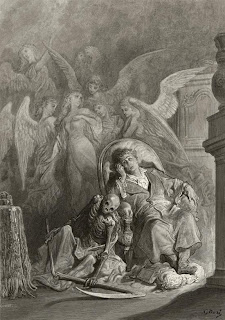

vainly I had sought to borrow, from my books surcease of sorrow

And the silken sad uncertain rustling of each purple curtain
Thrilled me - filled me with fantastic terrors never felt before;
So that now, to still the beating of my heart, I stood repeating
`'Tis some visitor entreating entrance at my chamber door -
Some late visitor entreating entrance at my chamber door; -
This it is, and nothing more,'

Presently my soul grew stronger; hesitating then no longer,
`Sir,' said I, `or Madam, truly your forgiveness I implore;
But the fact is I was napping, and so gently you came rapping,
And so faintly you came tapping, tapping at my chamber door,
That I scarce was sure I heard you' - here I opened wide the door; -
Darkness there, and nothing more.

Deep into that darkness peering, long I stood there wondering, fearing,
Doubting, dreaming dreams no mortal ever dared to dream before
But the silence was unbroken, and the darkness gave no token,
And the only word there spoken was the whispered word, `Lenore!'
This I whispered, and an echo murmured back the word, `Lenore!'
Merely this and nothing more.

Back into the chamber turning, all my soul within me burning,
Soon again I heard a tapping somewhat louder than before.
`Surely,' said I, `surely that is something at my window lattice;
Let me see then, what thereat is, and this mystery explore -
Let my heart be still a moment and this mystery explore; -
'Tis the wind and nothing more!'

Open here I flung the shutter, when, with many a flirt and flutter,
In there stepped a stately raven of the saintly days of yore.
Not the least obeisance made he; not a minute stopped or stayed he;
But, with mien of lord or lady, perched above my chamber door -
Perched upon a bust of Pallas just above my chamber door -
Perched, and sat, and nothing more.


Then this ebony bird beguiling my sad fancy into smiling,
By the grave and stern decorum of the countenance it wore,
`Though thy crest be shorn and shaven, thou,' I said, `art sure no craven.
Ghastly grim and ancient raven wandering from the nightly shore -
Tell me what thy lordly name is on the Night's Plutonian shore!'
Quoth the raven, `Nevermore.'


Much I marvelled this ungainly fowl to hear discourse so plainly,
Though its answer little meaning - little relevancy bore;
For we cannot help agreeing that no living human being
Ever yet was blessed with seeing bird above his chamber door -
Bird or beast above the sculptured bust above his chamber door,
With such name as `Nevermore.'

But the raven, sitting lonely on the placid bust, spoke only,
That one word, as if his soul in that one word he did outpour.
Nothing further then he uttered - not a feather then he fluttered -
Till I scarcely more than muttered `Other friends have flown before -
On the morrow he will leave me, as my hopes have flown before.'
Then the bird said, `Nevermore.'

`Other friends have flown before - On the morrow he will leave me, as my hopes have flown before.'


Startled at the stillness broken by reply so aptly spoken,
`Doubtless,' said I, `what it utters is its only stock and store,
Caught from some unhappy master whom unmerciful disaster
Followed fast and followed faster till his songs one burden bore -
Till the dirges of his hope that melancholy burden bore
Of "Never-nevermore."'

But the raven still beguiling all my sad soul into smiling,
Straight I wheeled a cushioned seat in front of bird and bust and door;
Then, upon the velvet sinking, I betook myself to linking
Fancy unto fancy, thinking what this ominous bird of yore -
What this grim, ungainly, ghastly, gaunt, and ominous bird of yore
Meant in croaking `Nevermore.'


This I sat engaged in guessing, but no syllable expressing
To the fowl whose fiery eyes now burned into my bosom's core;
This and more I sat divining, with my head at ease reclining
On the cushion's velvet lining that the lamp-light gloated o'er,
But whose velvet violet lining with the lamp-light gloating o'er,
She shall press, ah, nevermore!

Then, methought, the air grew denser, perfumed from an unseen censer
Swung by Seraphim whose foot-falls tinkled on the tufted floor.
`Wretch,' I cried, `thy God hath lent thee - by these angels he has sent thee
Respite - respite and nepenthe from thy memories of Lenore!
Quaff, oh quaff this kind nepenthe, and forget this lost Lenore!'
Quoth the raven, `Nevermore.'

Nepenthe

`Prophet!' said I, `thing of evil! - prophet still, if bird or devil! -
Whether tempter sent, or whether tempest tossed thee here ashore,
Desolate yet all undaunted, on this desert land enchanted -
On this home by horror haunted - tell me truly, I implore -
Is there - is there balm in Gilead? - tell me - tell me, I implore!'
Quoth the raven, `Nevermore.'


Is there, IS THERE balm in Gilead?


`Prophet!' said I, `thing of evil! - prophet still, if bird or devil!
By that Heaven that bends above us - by that God we both adore -
Tell this soul with sorrow laden if, within the distant Aidenn,
It shall clasp a sainted maiden whom the angels named Lenore -
Clasp a rare and radiant maiden, whom the angels named Lenore?'
Quoth the raven, `Nevermore.'

`Be that word our sign of parting, bird or fiend!' I shrieked upstarting -
`Get thee back into the tempest and the Night's Plutonian shore!
Leave no black plume as a token of that lie thy soul hath spoken!
Leave my loneliness unbroken! - quit the bust above my door!
Take thy beak from out my heart, and take thy form from off my door!'
Quoth the raven, `Nevermore.'

And the raven, never flitting, still is sitting, still is sitting
On the pallid bust of Pallas just above my chamber door;
And his eyes have all the seeming of a demon's that is dreaming,
And the lamp-light o'er him streaming throws his shadow on the floor;
And my soul from out that shadow that lies floating on the floor
Shall be lifted - nevermore!


And my soul from out that shadow that lies floating on the floor/Shall be lifted - nevermore!


PS: "But in the Cosmos there is balm as there is bitterness and that balm is nepenthe" H.P. Lovecraft, The Outsider